
The Value of the Surprise Find
Rooted in the Karang Guni (rag-and-bone) trade of the 1970s, Hock Siong was formally established in the 1990s, built on the work of clearing, buying, repairing, and finding value in what others had let go of.
In time, the family business grew into one of Singapore’s most recognisable names for second-hand furniture, part of a disappearing old trade that still knew how to find value where others had moved on. Its warehouse held mismatched cabinets, hotel linen, chairs, framed art and sculptures, each waiting for the right person to see what it could still become.
As the third generation stepped further into the business, Hock Siong faced a harder question than it first seemed. In a market shaped by the convenience of online shopping, should a store built on breadth of products start behaving more like a boutique?
Our work helped Hock Siong see that its odd mix was not a disadvantage, but a belief to build around.
The Unlikely Appeal of Things Out of Place
As customers grew used to tidier, easier ways of shopping, second-hand furniture retailers began moving towards tighter curation, following whichever style the market happened to be circling.
But Hock Siong was never built for that kind of neatness.
It does not operate like a conventional store, but a working warehouse where different eras, materials, price points and conditions meet in the same place. A school chair might sit around an Italian designer table, near a rosewood cabinet from an unknown era, a statue of a fish, and a stack of linen that only makes sense once someone wants it.
The strategic question was not which trend Hock Siong should follow, but how to help more people understand what made its unexpected mix valuable.
Behind the Breakthrough
SEEN & UNSAID
Hock Siong was already loved by a loyal community. Its reputation was built around trust, responsiveness and the regular thrill of new arrivals. Still, second-hand often carries old assumptions: dusty, cheap, random or make-do. Those perceptions also shaped the owners’ questions about where the business should go next.
Was the eclecticism holding the brand back? Would a more curated direction make Hock Siong easier to understand? Could the offerings be taken more seriously without becoming more polished?
We interviewed customers to find out more:
“One of the few places where people remember customers and bother to chat about their lifestyle, homes and what they need.”
“You gotta go because you might find a piece of your life. Nice, special, quirky. It’s like a cave of wonders. Little jewels.”
“They are not trying to push things on you to buy at your own detriment. They also don’t care if you like it or not. Prices are very fair.”
— Participants, Customer Interviews
The Brand Audit surfaced tensions and critical gaps:
The Hock Siong warehouse offered something increasingly uncommon: useful friction. For the sake of convenience, people often lose the pleasure of browsing without being over-directed. Hock Siong’s product mix gets customers to slow down, look closer and form their own connections.
For those who returned often, the point was not a perfectly edited showroom. It was the possibility of finding something they did not know they were looking for. When so many customers shared similar sentiments, it pointed the way for everyone involved. Choosing to stay the same can look like doing nothing. Here, it meant making a deliberate call: turn a perceived disadvantage into a calling card.
BELIEF & MOMENTUM
We centred the brand strategy around the 'joy of wandering' a proposition broad enough to carry the business because it came from how Hock Siong already worked: the best finds are rarely found in straight lines.
By leaning into a brand truth instead of narrowing itself, Hock Siong stands apart as the contrarian in its own lane.
This strategy also reframed how its goods can be perceived. In the wrong frame, second-hand furniture can look unwanted. At Hock Siong, a piece found by chance can feel like fate; a small victory for the person who saw it first. That changes the value of the object.
CHARACTER & FORM
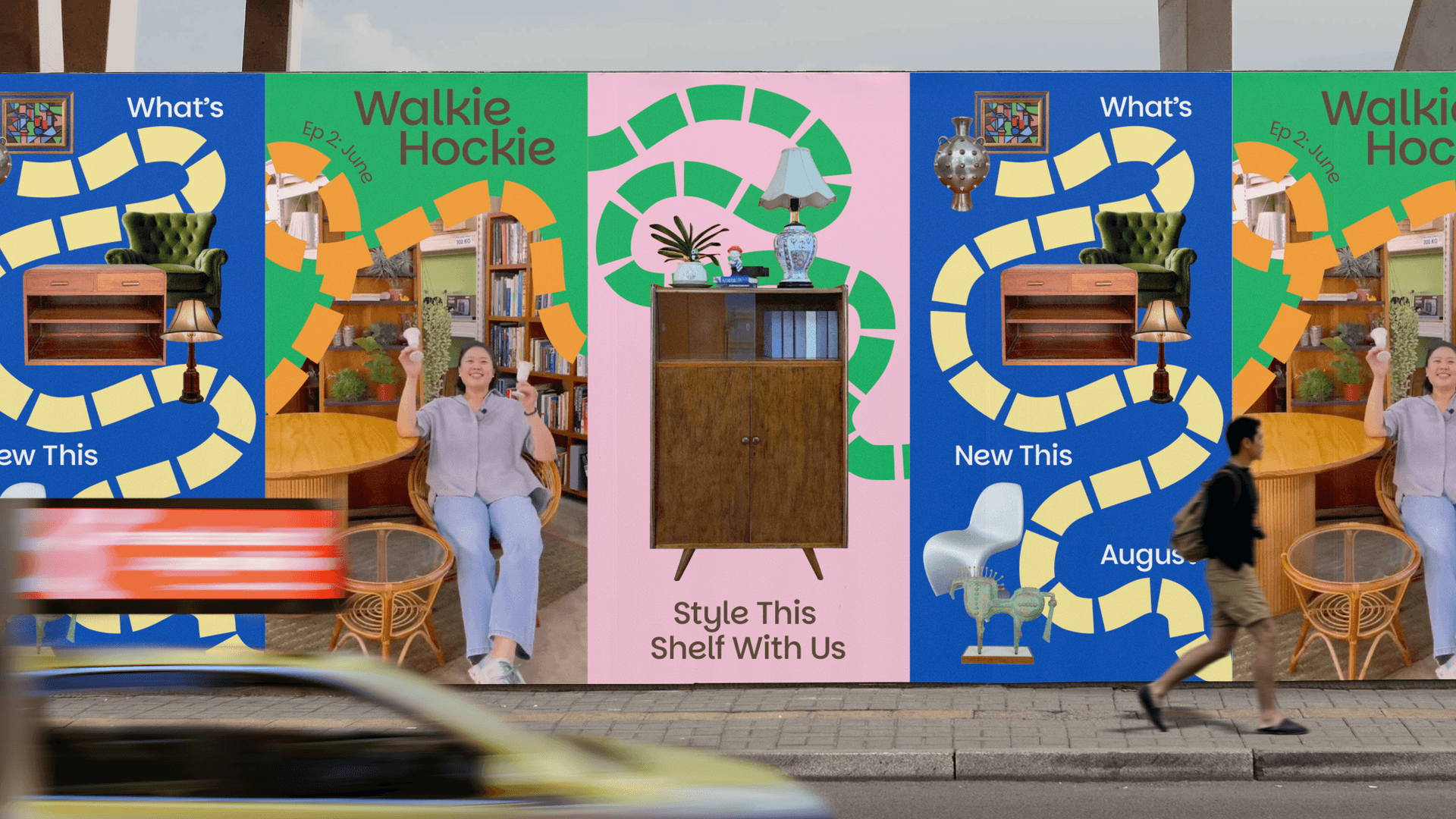
Rather than turn Hock Siong’s brand refresh into a generic boutique furniture exercise, we took a contemporary vernacular approach: one that honours its karang guni roots while reflecting the pre-owned furniture store it has become today.
Visual Identity
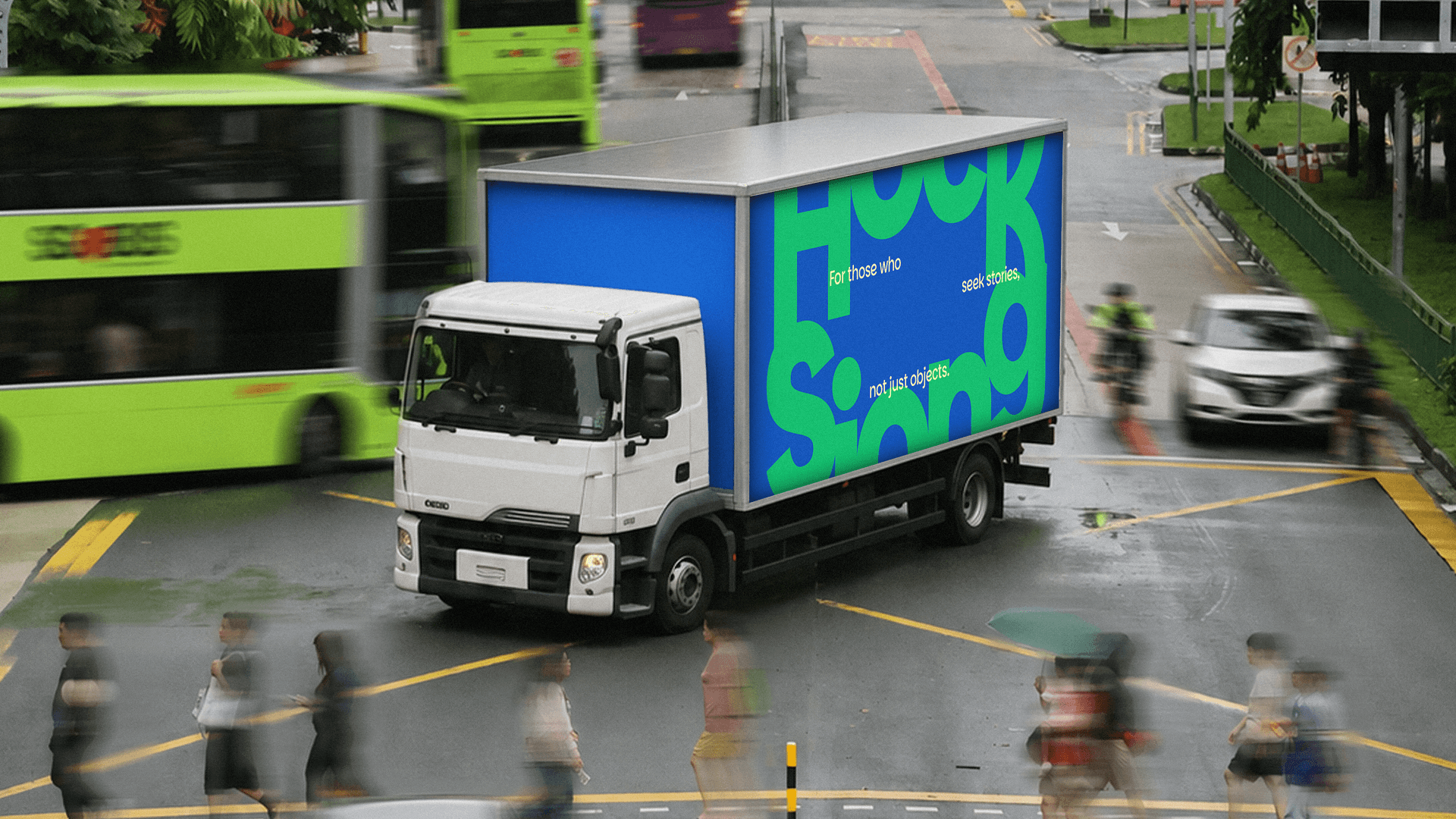
The refreshed identity had to feel useful, warm and full of life; proud of its history, but not trapped in it. The logo is set in a closed circular form, echoing the cycle of second-hand goods where every piece continues its journey in a new home.
The secondary pathway graphic captures the loops, turns and detours of browsing through the warehouse. It turns the act of wandering into a bold visual language: flexible, distinctive, and true to how people actually experience Hock Siong.
Colour brings the brand’s spontaneous character forward. The palette is joyful, clashing and energetic, allowing the identity to feel as lively as the finds themselves.
Tone mattered as much as form. Hock Siong needed to sound like the people behind the business: direct, good-humoured, helpful, and quietly sure about what deserves another chance.
The result is a brand that does not tidy away its uniqueness. It gives that oddness a recognisable voice, shape and rhythm.
Digital Experience
The webstore extends the warehouse without flattening it. We shaped the online experience to support browsing, translating its mix-and-match warehouse into an online feature alongside a more conventional webstore for customers ready to act quickly.
The refreshed digital experience makes the brand easier to enter from anywhere: to browse, wander and learn the history behind the business.
“Having been in this industry for some time, my perspective can naturally become a little myopic. Working with Somewhere Else, especially through the research process, allowed me to step outside of that and see Hock Siong through a third-party and customer lens.”
Outcomes
Hock Siong now has a brand that amplifies what people love it for, while helping the third-generation business move forward on its own terms. The refreshed identity and webstore turn a familiar warehouse experience into a more recognisable brand of discovery. What was once understood only after visiting in person can now be felt online: the surprising mix of products and the quiet satisfaction of giving good things another life.
Most importantly, the work helped Hock Siong stay the course with more conviction, because sometimes, the harder move is not to change.